The Myth of the One Hidden Meaning in Every Artwork
Learn how to interpret an artwork through visible details and context, building several reasoned readings without treating the image as a riddle.
The most common mistake in interpreting an artwork is to assume that every detail points toward one concealed answer. That turns looking into a hunt for the artist’s private key, and it can make visible evidence seem less important than a confident guess. A more useful reading begins with what is actually there, then asks what those details can support.
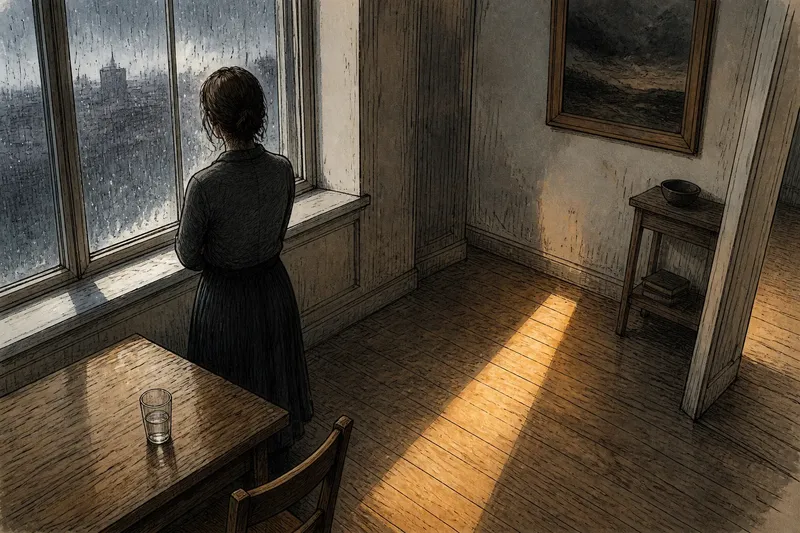
Imagine a clearly hypothetical situation: you are standing before an invented painting of a person beside a rain-darkened window. The person’s face is turned away, a glass sits untouched on a table, and a narrow strip of warm light falls across the floor. Nothing in the scene announces a single meaning. Its details invite several readings, but they do not make every reading equally persuasive.
Begin with the visible
Before assigning symbolism, describe the painting in plain language. There is one figure, positioned near the window; the glass is separate from the figure; the light reaches the floor but not the face. These statements may sound modest, yet they create a shared record that another viewer can inspect.
Then notice how the composition directs attention. The turned head withholds an expression, while the bright strip of floor competes with the figure for emphasis. The untouched glass introduces a small question about time or intention, but it does not answer that question by itself.
Keep observation and interpretation distinct. “The person looks lonely” is an interpretation; “the person faces the window and does not touch the glass” describes visible details. The first may prove useful, but the second gives it a basis.
Build readings from clues
In this invented painting, one reasonable reading is that the figure is waiting. The outward-facing posture and the rain-darkened window suggest attention to something beyond the room; the untouched drink may imply that the person has been there for a while. Yet waiting remains an inference, not a fact printed into the image.
A second reading might treat the scene as a moment of withdrawal. The turned face keeps the viewer at a distance, and the person’s separation from the glass and light makes the room feel divided. That interpretation emphasizes what the figure does not meet: another person, the viewer’s gaze, or even the patch of warmth nearby.
A third reading could focus on the contrast between weather and light. Rather than making the figure’s mood central, it might see the painting as a study of how a room changes under passing conditions. This account gives more weight to the window, floor, and shifting illumination than to a story about the person.
These readings differ, but each can point to details that help make it plausible. A useful interpretation explains why the painting is arranged as it is; it does not simply attach a familiar symbol to one object. If a reading depends on a detail the image does not contain, or ignores a prominent detail that complicates it, it needs revision.
Context without a master key
Context can sharpen a reading, but it rarely turns an artwork into a code with one authorized solution. Useful context might include the medium, the work’s setting, the conventions of its genre, or information supplied by a museum label. Each can change what a viewer notices without erasing the evidence in the image.
Suppose the invented painting is presented as part of a group of interiors made for a public exhibition. That setting might encourage questions about domestic space and who is allowed to occupy it. If it appears instead in a room devoted to studies of light, the contrast between rain and warm illumination may become more prominent. Neither setting makes the other details disappear.
Context is most helpful when it opens a question that the work can answer in part. A label identifying the figure as a particular kind of worker, for instance, might make the untouched glass seem connected to interrupted labor. But unless the work or reliable contextual information supports that claim, the viewer should not treat it as settled biography.
When does a reading fit?
Can one artwork have several meanings?
Yes. Different readings can emphasize distinct relationships among the same visible details, especially when an artwork leaves motives or events unstated. Several readings remain disciplined when each can identify evidence and acknowledge what it cannot establish.
How do I separate evidence from projection?
Ask which exact features led you to an interpretation, then describe them before naming their possible meaning. If the explanation relies mainly on your own memories or assumptions, it may be a personal response rather than a claim about what the work shows.
Does the artist’s intention settle the meaning?
Reliable statements about intention can add important context, but they do not automatically exhaust what an artwork communicates to viewers. A maker’s stated aim and the work’s visible effects may align, differ, or leave questions open.
When should I reject an interpretation?
Set aside a reading when it depends on invented details, contradicts prominent evidence, or cannot explain why its favored features matter. A less dramatic account that fits the whole work is often stronger than a clever claim that explains only one corner.
Let readings compete
Return to the hypothetical painting and compare the three accounts. The waiting interpretation explains the gaze toward the window and the unused glass, but it assumes an anticipated arrival. The withdrawal interpretation accounts for distance and concealment, but it may underplay the light. The study-of-light reading explains the strong contrast, though it may make the figure seem incidental.
That comparison does not require choosing a winner. You might instead say that the painting holds a person in a private interval while making light and weather unusually prominent. This phrasing keeps the figure’s possible state open and describes the tension the composition makes visible.
Try this method with a work that initially seems mysterious:
- Name the objects, figures, colors, gestures, and spatial relationships you can point to.
- Separate direct description from words that already imply a motive or emotion.
- Offer a reading and connect each central claim to specific visible evidence.
- Construct a different reading from the same details rather than inventing new ones.
- Check whether context supports, complicates, or merely distracts from each account.
- Keep the uncertainty that the artwork itself leaves unresolved.
These actions are not a formula for uncovering a hidden answer. They are a way to make interpretation accountable: another viewer can see which details your account attends to and where your inference begins.
Keep the question open
The imagined viewer can leave the painting with more than one account and still have learned something precise. The person may be waiting, withdrawing, or simply sharing the room with a changing field of light. What remains secure is the arrangement that makes those possibilities available: a turned face, an untouched glass, rain at the window, and warmth on the floor.
The myth of the one hidden meaning makes ambiguity look like a failure to solve the work. In practice, ambiguity can be part of what the work does. A careful reading does not turn uncertainty into a secret; it shows how far the visible details and context can take us, then stops where the evidence stops.
When you next interpret an artwork, write down one observation before writing down what you think it means. That small pause keeps the image in the conversation—and leaves room for another reasoned reading.