Before the Sketchbook: Where Artists Kept Working Drawings
Where artists kept working drawings depended on purpose and access. Learn how sheets, pattern books, workshop walls, and portfolios preserved ideas in use.
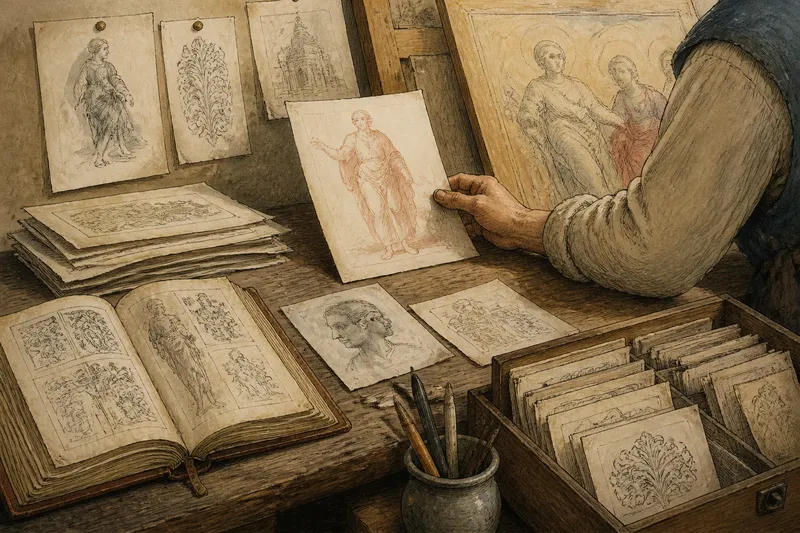
The common mistake is to imagine that artists always carried a bound sketchbook, filling it from page one onward. Before that personal format became familiar, working drawings were often loose sheets, grouped by task or kept where a workshop could use them; treating them as a diary can obscure their practical purpose.
Where artists kept working drawings depended on what the marks were for, who needed to see them, and whether they had to survive the next stage of making. Some designs remained near a workbench, while others entered collections of patterns, models, or preparatory studies. The paper’s location was part of the working method.
Where artists kept working drawings
There was no single container. Drawings might be pinned or laid out in a studio, stored in folders or boxes, bound into albums, or incorporated into a pattern book. A sheet could also travel between an artist, a workshop assistant, and a patron before reaching any lasting collection.
Different arrangements answered different needs. Loose paper could be rearranged as a design changed; a bound volume kept related images together; a wall display let several people consult a model. Storage did not simply protect a drawing—it determined how easily someone could compare, copy, or revise it.
Why use loose sheets?
Loose sheets were useful when a drawing had to move, be sorted, or serve as a template. A workshop could place a model beside the material being worked, pass it to a specialist, or file it with other designs of the same kind. The sheet’s independence made it adaptable, but also made it vulnerable to separation from its original context.
Artists and workshops could group loose drawings by subject, commission, or stage of work. A brief note, label, or mark might help identify a sheet later, though not every drawing carried enough information to explain its first purpose. When a loose sheet survives alone, its neatness or apparent finish cannot by itself tell you whether it was a preliminary thought or a usable model.
What did pattern books do?
Pattern books gathered designs that could be consulted again, copied, or adapted. They might contain motifs, figures, ornaments, or models for particular kinds of work. Unlike a purely personal record, a working collection could serve several hands and recur across different projects.
Binding made a collection easier to keep together, but did not necessarily make it a chronological account. Pages could be added, removed, or rearranged; images might have been copied from other sources or assembled for practical reference. A pattern book is best read as a resource in use, not automatically as a record of one artist’s development.
How did workshops share drawings?
A workshop needed drawings to communicate decisions: a pose, an ornament, a composition, or a detail that someone else would carry forward. A model could be displayed where workers gathered, kept near the relevant tools, or passed to the person responsible for the next task. The drawing’s audience could therefore be a group rather than its maker alone.
Imagine a small workshop preparing a painted panel. The master keeps a figure study on a loose sheet, places it beside the panel for an assistant to consult, then stores it with related models when the work moves on; the expected result is that the pose remains available without requiring the assistant to rely on memory. This imagined situation shows why a working drawing might be valued for clarity and reuse, not for private expression.
Why were drawings bound?
Albums and bound collections could protect sheets and keep a set of images in one place. A collector, workshop, or later owner might bring drawings together, sometimes adding inscriptions or ordering them by subject. Binding could preserve a useful grouping, but the grouping might reflect a later owner’s choices rather than the original artist’s plan.
That distinction matters when examining a bound volume. Look for changes in paper, mounting, page order, and handwriting; these features can suggest that the book was assembled over time. A drawing’s neighbors may help explain how it was later used, but they are not automatic proof that the images began together.
What can a drawing’s storage reveal?
Storage offers clues about function, not a complete biography. Pinholes or wear may indicate handling or display; folds can suggest transport; trimming or mounting may show that a sheet was adapted for another setting. Each clue is strongest when considered alongside the drawing’s subject and the way its marks are made.
Keep observation separate from certainty. A hole near an edge may be consistent with pinning, for instance, but without further evidence it does not establish where the sheet hung or who consulted it. The practical question is what the physical evidence supports—and what remains unknown.
How should you read a working drawing?
Was every working drawing preparatory?
No. Some drawings explored an idea before production, while others functioned as models to copy, references for a particular detail, or records of a design already in use. The marks and physical condition can help distinguish possibilities, but purpose may remain uncertain.
Did artists keep drawings in one place?
Not necessarily. A sheet could move between a work surface, a shared workshop area, and a later collection. Its route depended on whether it was needed for making, teaching, copying, or keeping.
Was a pattern book the same as a sketchbook?
Not in purpose or arrangement. A pattern book generally gathered images for reference and reuse, whereas a sketchbook often suggests a more personal, continuous sequence of pages. The terms can overlap in practice, so the book’s contents and organization matter more than its label.
Can storage identify the artist?
Storage alone rarely settles authorship. An inscription, paper, handling marks, and style may contribute evidence, but a later owner could have gathered work by several makers in one volume. Treat the collection history as one clue among others.
What survives in collections?
Loose sheets and bound volumes reach us through uneven routes: they may be preserved, dispersed, mounted, or gathered by later collectors. That means surviving arrangements are not a transparent picture of how every artist worked. A tidy album may be the result of later organization, while a scattered set may once have belonged to a coherent workshop practice.
When you encounter a drawing, start with what can be seen: whether it is loose or bound, how it is marked, and what signs of handling remain. Then ask who might have needed it and what work it could have supported. Where artists kept working drawings is not merely a question of furniture or containers; it is a way to see how an image moved from one hand, task, or purpose to another.