A Gallery Visit Built Around One Room
A gallery visit built around one room gives you time to notice a work’s surface, setting, and details without rushing through the rest of the museum.
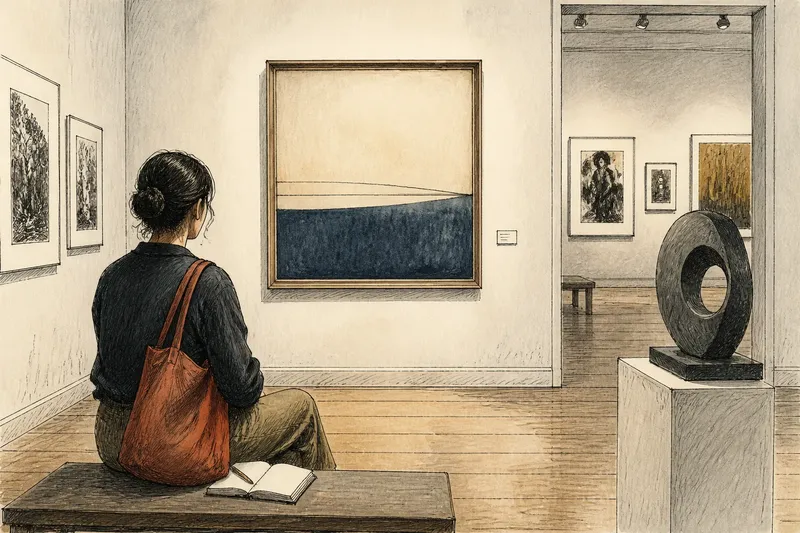
The most common mistake on a gallery visit is treating every room as a stop to complete; the cost is a blur of works you barely remember. A gallery visit built around one room offers a quieter alternative: look across the space, choose one work, then return to it with a more particular question in mind. You do not need to see the whole museum for the visit to feel complete.
Set a smaller boundary
A museum encourages movement. Open doorways, sightlines, and wall labels suggest that the next room is always waiting. Choosing one room changes the measure of a visit from how much ground you cover to what you can attend to while staying put.
Pick a room that feels workable rather than impressive. A modest space with a few paintings, a sculpture gallery, or a room of prints can all hold enough to notice. If a room is crowded, noisy, or difficult to settle in, choose another; the plan is meant to lower pressure, not create a new obligation.
Before entering, decide what “one room” means for you. It might be a single gallery, or a compact section within a larger space. You can leave whenever you need to. A boundary is a permission to stop, not a rule that must be obeyed.
Look before choosing
On entering, resist the urge to select a favorite immediately. Stand where you are not blocking other visitors and let your eyes move around the room. Notice the spacing between works, the height at which they hang, and whether the light falls evenly or gathers in one area.
This first pass is not a test of connoisseurship. You are gathering impressions before labels and interpretations begin to steer attention. A large canvas may dominate from the doorway, while a small drawing only becomes visible once you move closer. Both kinds of presence can be worth following.
Then let your attention pause where it naturally does. Perhaps a repeated shape draws you across several works; perhaps one object seems strangely quiet beside its neighbors. You do not have to explain the response. Simply notice where you want to look again.
Choose one work
Choose a work that gives you something to stay with, not necessarily the one you think you are supposed to admire. It may be a painting, a photograph, a textile, a sculpture, or a sheet of paper in a case. A clear reason is optional: “I keep looking at that corner” is enough.
Find a comfortable viewing position. For a painting, a few steps back may reveal its overall arrangement; closer in, the surface may show brush marks, patches of color, or changes in texture. With sculpture, a small shift to the side can alter the relation between forms. Keep a respectful distance and follow any museum guidance around objects and barriers.
Begin with what is plainly visible. Describe the work to yourself without naming what it means: a dark band crosses the lower edge; a figure turns away; a rough area sits beside a smooth one. This kind of description makes room for interpretation without rushing into it.
Say you enter a room of prints and keep noticing a narrow, pale line in one image. You choose that print, first seeing it as a dark field interrupted by the line; after reading its label, you return and notice that the line changes direction near the edge. The useful result is not a solved meaning, but a more precise account of what the work lets you see.
Return with a question
After the first look, step away briefly. Read the label if you want context, or look at another work nearby before coming back. The interval helps distinguish what you noticed on your own from what the label adds: materials, subject, place of origin, or an artist’s stated intention.
When you return, bring one small question rather than a demand for a complete explanation. Where does the eye go first? What changes at the edge? Which parts seem carefully finished, and which remain open or rough? A useful question gives your attention somewhere to land.
Look for relationships within the work. A color may echo across separate areas; a repeated gesture may become less obvious at a distance. In a sculpture, the space around an opening can matter as much as the solid material. In a drawing, a blank area may feel active because marks gather beside it.
Then consider the room without turning it into a puzzle. Does the work look different beside a brighter image, a neighboring sculpture, or a wall label? The museum’s arrangement shapes what is easy to notice, but it does not dictate a single response. You can register the setting and still let the work retain its own character.
What should you notice on a second look?
Should you read the label first?
Either order can work, but looking briefly before reading gives you a chance to form an independent impression. The label can then add useful context rather than replace your first observation.
How close should you stand?
Choose a distance that lets you see the work clearly without crossing barriers or disturbing others. For many works, moving between a farther view and a closer permitted view reveals different kinds of detail.
What if nothing holds your attention?
Let your gaze travel through the room again and choose a feature rather than a whole work: a material, a repeated shape, or an unusual scale. If nothing invites another look, it is fine to leave the room.
Do you need to understand the work?
No. Careful looking can deepen a visit even when the subject or intention remains uncertain. You can leave with a clear observation and an unanswered question.
Compare without ranking
Returning to one work does not mean ignoring everything else. After spending time with your choice, glance at a nearby work and compare one feature: the density of marks, the use of empty space, the material, or the direction of a figure’s gaze. The point is to notice difference, not decide which work is better.
Comparison can sharpen attention to the original choice. A spare composition may seem even quieter beside a crowded one; a polished surface may make a neighboring rough texture more conspicuous. Keep the comparison narrow. If you try to account for every difference, you may drift back into hurried surveying.
The room itself can also provide a gentle sequence. You might move from a work that caught your eye to one that shares its color, then return to see whether the first now reads differently. This is not a route to a final answer. It is a way to notice how context adjusts attention.
Let the visit stay open
When you feel ready to leave, pause once more with your chosen work. You might name one detail you had missed, one question that remains, or one feature you would recognize again. A short note in a small notebook can preserve that observation; a sentence is enough. If writing would interrupt the visit, keep the note for afterward.
There is no need to stay until the room has yielded a complete interpretation. Attention changes with fatigue, crowding, and mood, and a short visit can be more attentive than a long one. Leave when the looking begins to feel forced, or when another part of the museum genuinely calls to you.
A gallery visit built around one room works because it gives attention somewhere to return. The next time you enter a museum, choose one room, make a first pass, and follow a single detail back into view. You may remember not everything in the room, but a particular surface, spacing, or shift in perception can travel with you after you leave.